Bellweather Cove
Unchosen By My CEO Husband: A Marriage In Crisis Second Chance RomanceBellweather Cove is the lakeside refuge that breaks the spatial and social logic of Jacinta Colt’s marriage. Associated with her grandmother’s house, the town gives Jacinta a place to leave the Colt household, recover the work and identity that had been treated as secondary, and build a community institution in which authorship is visible, shared, and protected. Its decisive significance lies in the contrast it creates: the world that reduced Jacinta to a marital title is set against a place where her name can stand on a wall and her decisions can shape an entire house of care.
Definition and Setting
Bellweather Cove is a town beside the lake and the location of the house known as Haven House, which Jacinta describes as her grandmother’s place. When she leaves Aaron Colt, she does not retreat to an anonymous hotel or accept a temporary cooling-off period. She tells Aaron that she and the children are going to Haven House in Bellweather Cove and that she has already emailed the school. The destination therefore represents a deliberate relocation of family life, not an impulsive disappearance.
The journey north gives the place a threshold quality. Jacinta drives away from the Colt household with her laptop, a folder containing the evidence she has been keeping, and a ten-year-old paper written in Aaron’s handwriting. She heads toward the lake and toward the house her grandmother left to “the granddaughter everyone counted out.” By the time she reaches that road, she no longer checks the clock or worries about being expected somewhere. Bellweather Cove is thus introduced as a geography of release from schedules, duties, and judgments that had previously defined her existence.
A Counter-Space to the Colt Household
The town’s importance is established through what its residents do not do. In Bellweather Cove, nobody has called Jacinta scattered, treated being overwhelmed as a diagnosis, or watched her fidget while calculating whether she was fit to manage her own life. The absence of this scrutiny becomes evidence that the defect was not in Jacinta but in the environment that interpreted her behavior as proof against her.
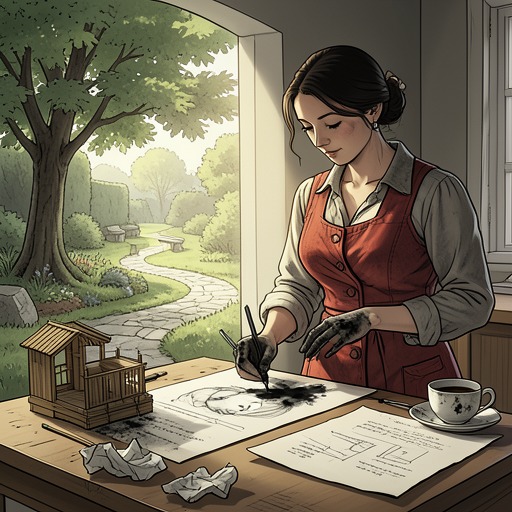
Bellweather Cove also gives her access to ordinary civic work. In February, when the library board needed someone to repair the reading room, someone recommended Jacinta. She completed the work for almost nothing and placed a small brass plaque at child height, where young readers could touch it. The inscription reads “Designed by Jacinta Colt.” In a place that does not strip her name from useful labor, recognition is neither a favor nor a decorative afterthought; it is attached directly to the work.
The town consequently changes the meaning of visibility. At the pre-gala dinner, Jacinta’s place card identifies her only as “MRS. AARON COLT,” while Beatrice Colt, Celeste Colt, Aaron Colt, and even the absent Cassandra Vale have their own names. Bellweather Cove supplies the opposing inscription. Its library plaque and later Haven House charter make Jacinta’s name an accountable record of contribution rather than a marital status imposed by others.
Haven House and the Recovery Gardens
The house in Bellweather Cove becomes the base for Haven House Recovery Gardens, which develops from refuge into a functioning community of care. By ten o’clock on the opening day, the old camp is full. The gardens have been planted over the summer by Noah’s crew and half the town, with lavender, sage, and lake-country roses arranged along paths wide enough for people to walk side by side. Railings are installed throughout because, in the book’s recurring formulation, railings are promises: the built environment is designed to support people rather than measure them against an inaccessible standard.
The interior details extend the same principle. Quiet rooms have soft light and deep chairs; the kitchen has bins, labels, and a four-color calendar. These are concrete adaptations that turn domestic organization into care instead of control. On the wall, at child height, hangs the plaque identifying “The Haven House Recovery Gardens. Founder and designer: Jacinta Colt.” The institution does not merely shelter people; it records who made the shelter possible.
Bellweather Cove’s community participates in this transformation. Carol from the diner cries first and the library board cries second, recalling the civic network that had already accepted Jacinta’s work. Sixty folding chairs appear again, but the gathering no longer serves a dynasty. Six women move in on Monday, six to begin with, and their names are promised a place on everything they make. Jacinta has written that rule into the charter in language a lawyer cannot undo. The town therefore becomes the social ground on which a different institutional ethic can be enforced.
Memory, Evidence, and Public Recognition
Bellweather Cove is connected to the recovery of suppressed history as well as to future construction. Jacinta arrives carrying evidence on her laptop and Aaron’s ten-year-old note against her skin. The move separates her from the office where the Vale contract is kept in a second drawer and from the household in which important facts are concealed among unlabeled folders. The town does not erase the past; it gives Jacinta enough distance to read it, name it, and decide what should follow her.
The later opening of Haven House also brings that history into public view. Elliot Grant travels from Chicago with Dana and gives Jacinta a frame containing page one of the original Renewal Centre proposal, marked with her initials and dated three years before any gala took place. The document confirms that her authorship preceded the public event through which credit was contested. In Bellweather Cove, the recovered page is not hidden evidence in a drawer but a framed object presented to the person whose work it records.
Narrative Significance
As a location, Bellweather Cove marks Jacinta’s movement from a fixed identity into a chosen one. The gold-lit hotel corridors and the office’s second drawer belong to a hierarchy in which access, naming, and information are controlled. Bellweather Cove works differently: a grandmother’s house becomes a refuge, a library becomes a site of authorship, and an old camp becomes a recovery garden whose architecture promises companionship and access.
The place also complicates the idea of escape. Jacinta leaves the Colt household, but Bellweather Cove is not merely a private sanctuary where she waits to be restored by Aaron Colt. Its residents help build the gardens, the library board recognizes her labor, and the women entering Haven House retain ownership of their names and creations. The town turns separation into production: distance from the old household makes possible a new institution.
By the time Haven House Recovery Gardens is full, Bellweather Cove has become the setting for a public answer to the erasures that defined Jacinta’s former life. Its most important landmarks are not inherited prestige or formal titles but the plaque at child height, the accessible paths, the labeled kitchen, the quiet rooms, the framed proposal, and the charter that protects credit. The lake town is therefore the novel’s clearest geography of reconstruction, where refuge acquires structure and a woman once reduced to “MRS. AARON COLT” is named as founder and designer.